
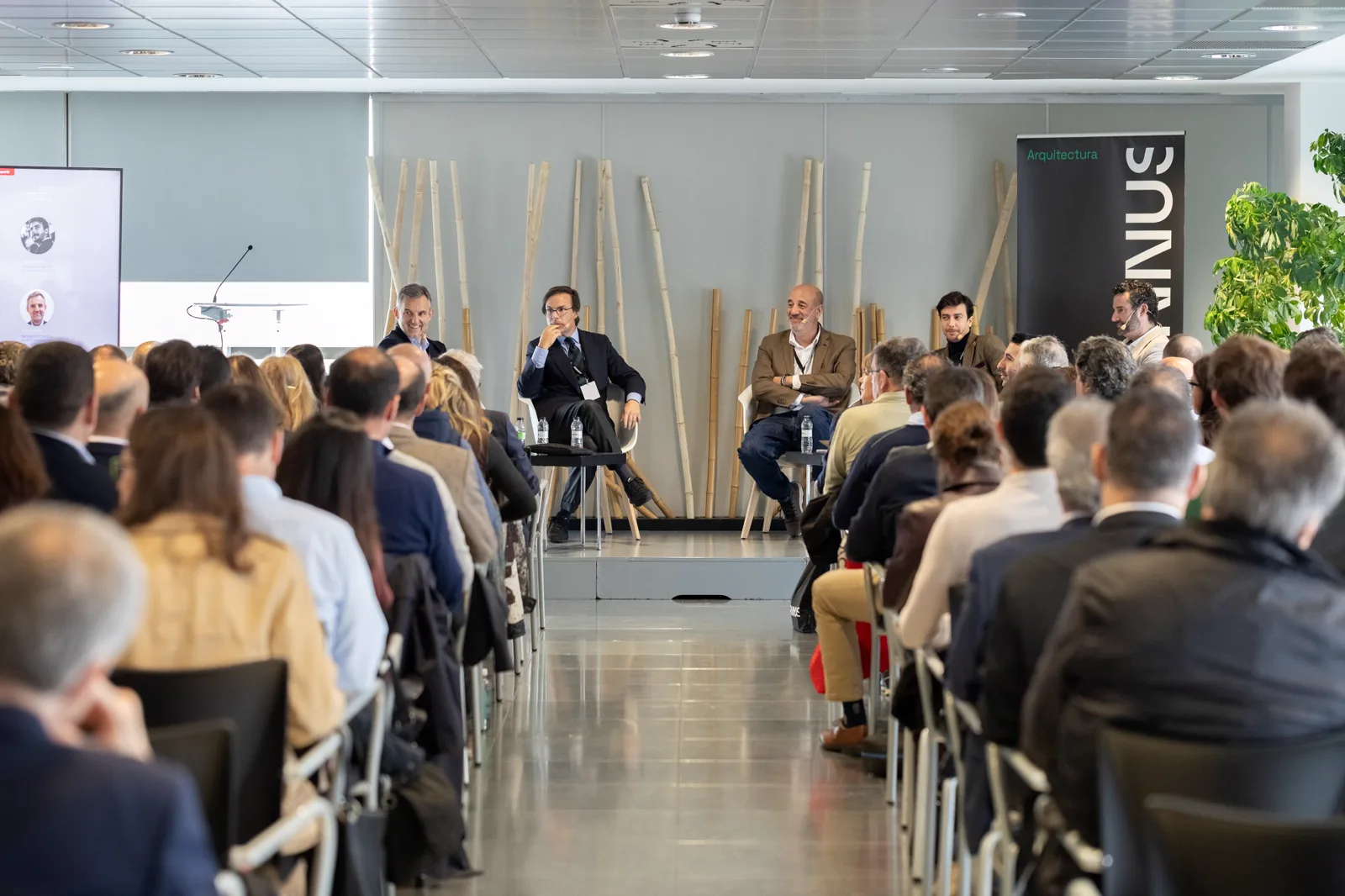
Zaragoza, November 2025 — The 4th "Innovation in Times of Change" conference gathered more than 190 professionals from architecture, development, construction and real estate investment in the Sala Panorámica of the World Trade Center Zaragoza on 14 November, to a full house. The event, organised every autumn by the University of Zaragoza's Real Estate Market Chair and the architecture firm Ingennus, has become an annual fixture for analysing the trends that are redefining how the spaces we live in are conceived, designed and built: new housing needs, the climate emergency, technological progress and digitalisation. The opening and closing sessions were led by Luis Fabra, director of the Chair, and Montse Rodrigo, Head of Communications and Marketing at Ingennus, and the conference was sponsored by Ibercaja, Grupo Plaza 14, the Spanish College of Registrars and the Aragon College of Real Estate Agents (API).
Flex living: universal solution or niche product?
The first of the programme's three round tables, "Flex living as a solution to the housing shortage", moderated by Enrique Santi, partner at Ingennus, brought together Íñigo Muñoz, Head of Investments at Overlord Gestión, with Juan de la Peña (Amira Real Estate), Juan Laiseca (STRACO Real Estate Iberia) and Xavier Robert (Olbers Real Estate). The speakers agreed to place flex living within the broad living ecosystem, as a category designed to meet very diverse housing needs, and from that shared definition went on to debate how far it can genuinely respond to the housing shortage.
The diagnosis was nuanced: the model has developed first in the cities with the strongest demand pressure —Madrid, Barcelona and Valencia— and, although it is beginning to spread to other areas, it remains frequently tied to high-rent products. The panel concluded that flex living is not a universal solution but a niche product capable of relieving part of the demand in those markets where traditional supply is not growing at the necessary pace.
That is familiar ground for the firm: it is developing three flex living vehicles in Madrid —Mad Río Hco, coliving and coworking beside the Manzanares river; Inversiones Valdemarín, a mid-stay aparthotel in Valdemarín (Moncloa-Aravaca); and Vik Living, in the south-east development of Vicálvaro—, in a market where regulated supply covers barely a fraction of demand.
Hybrid construction and artificial intelligence
The programme was completed by two further panels. The second, moderated by Marta Train (Ingennus), addressed sustainable hybrid construction —combining traditional building systems with industrialised solutions to balance cost, time and technical performance— with Pablo Saiz (Woodea), Juan Pedro Zárate (ACR), Manuel García (Cesefor) and Albino Angeli (Xlam Dolomiti). The third, "Architecture and the future: from pencil to algorithm", moderated by M.ª Eugenia López (Ingennus), brought together Fernando Iglesias (KronosHomes), Raúl Martínez (Twindocs), Víctor Ballestín (CIRCE) and Manuel Gimeno (SACO España) to examine the integration of artificial intelligence into architecture, with one underlying idea: its adoption requires data quality and a corporate strategy, and the key question for professionals will be what humans can contribute that the algorithm cannot.
Two weeks later, Overlord brought the sector together again in the Aragonese capital with a session on investing in equities and real estate at the Gran Hotel de Zaragoza.
The full programme is available on the Real Estate Market Chair's website, and reports on the event (in Spanish) from Ingennus and the Zaragoza Chamber of Commerce.
More information
Flex living in Madrid: a structural supply deficit